
STE80 Humanizer: rewrite AI text in manual-plain English
A skill that rewrites AI-written text "80% of the way to ASD-STE100", the tip Andrej Karpathy shared, and keeps every fact.
- Who
- Built by the team behind Dodaios, an open-source assistant that runs coding agents, for people who write and read with AI.
- When
- The repository opened on 9 November 2026. SKILL.md gives the current version as 4.0.0.
- Where
- Claude Code, Codex, Cursor and other agents the skills CLI reaches, plus Claude.ai and Claude Desktop.
What was hard
Ask an AI for a README or an email and you get "Great question!" followed by sentences that carry three ideas each. Deleting the obvious words does not help much: the long sentences with hidden actors and stacked hedges stay, and readers still feel a machine wrote it. The more text agents write, the more time people spend reading and understanding it.
What it does about it
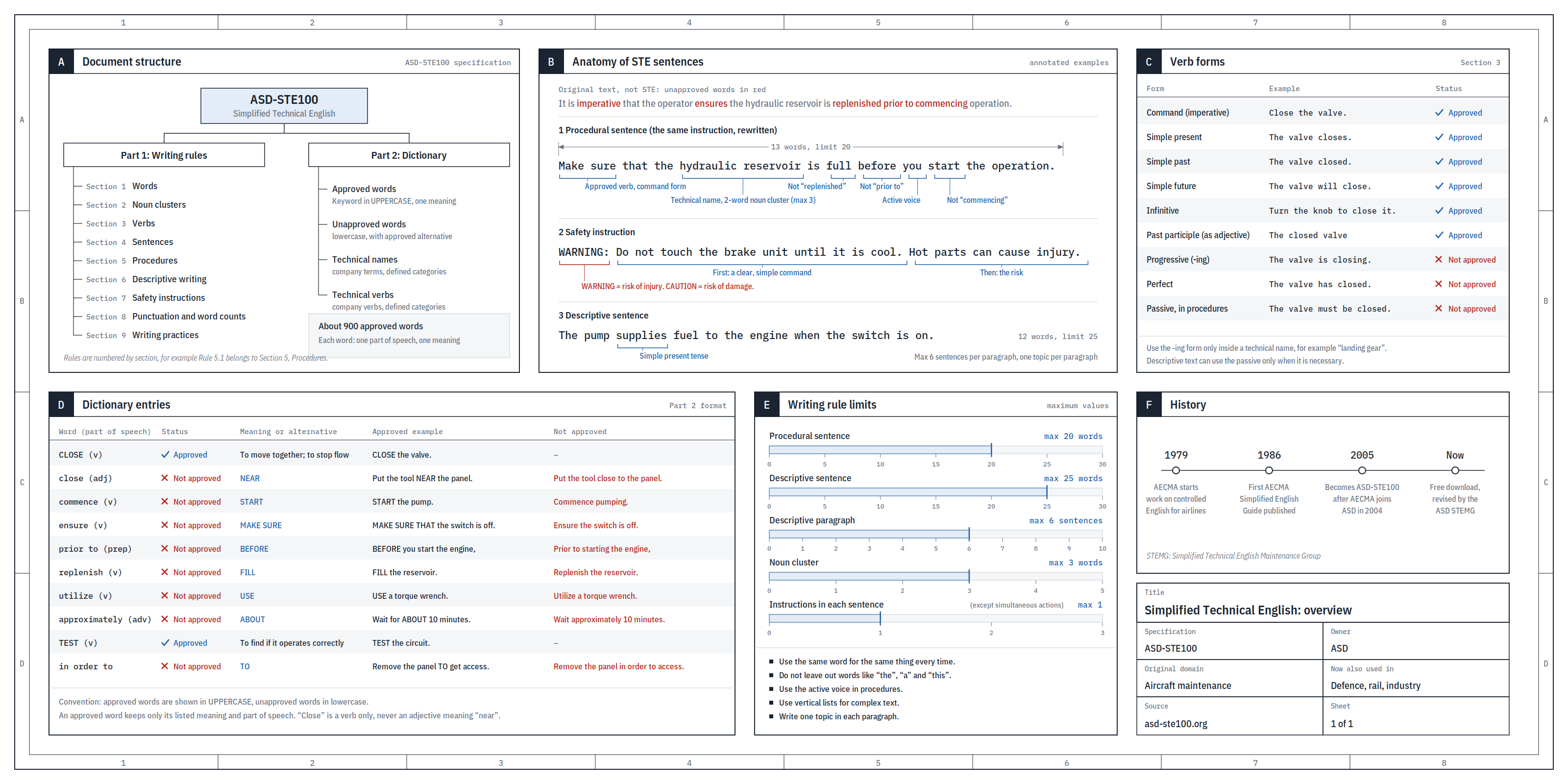
STE80 Humanizer edits the text in two passes. The first removes 26 AI tells taken from Wikipedia's "Signs of AI writing". The second rebuilds the sentences with the structure of ASD-STE100, the controlled English of aircraft maintenance manuals. The full spec makes normal prose stiff, so the default is 80%: all of the structure, and only as much of the vocabulary as sounds natural. It reports each edit by number, such as "§1, §8, S2", so you can look up why a line changed.
How it runs inside
- 1
You → Claude Code
/ste80-humanizer and pasted textPasting text or asking to make it sound like a person starts the skill.SKILL.md - 2
Claude Code → SKILL.md
List the factsIt notes each claim, number, name, date, condition and degree of certainty first.SKILL.md - 3
SKILL.md → references/
Pass 1: mark AI tells §1 to §26When a case is unclear it reads the full entry for the tell, with examples.references/ai-tells.md - 4
SKILL.md → references/
Pass 2: structure rules S1 to S15It marks sentences with more than one idea or 25 words, hidden actors and stacked hedges.references/ste80-rules.md - 5
Claude Code → scripts/ste_check.py
python scripts/ste_check.py <file>Optional: a linter with no dependencies flags leftover tells and sentence length.scripts/ste_check.py - 6
Claude Code → Rewrite and edit numbers
The rewrite + "§1, §8, S2"It compares the rewrite with the fact list, then returns it with the edits by number.SKILL.md
What goes in, what comes out
Is it for you
Good for
- Cleaning up a README, docs or a runbook your agent wrote before you publish it
- Taking only the AI tells out of an email or a LinkedIn post (Light mode)
- Turning a procedure or safety note into strict STE style (Strict STE mode)
- Asking whether a text sounds like AI, without a rewrite
Not for
- STE is an English standard. For other languages it applies the tells and structure rules, not the English word lists.
- For fiction, speeches and brand copy it does Pass 1 only. STE is for clear explanatory text.
- Getting past AI detectors is not a goal, and "STE style" is not official STE compliance.
- The README's comparison rests on four small test cases, which its authors call a hint, not proof.
Reviewed by Devalley’s editor before publishing. How the column is made