
rederive: learn a codebase by designing it again yourself
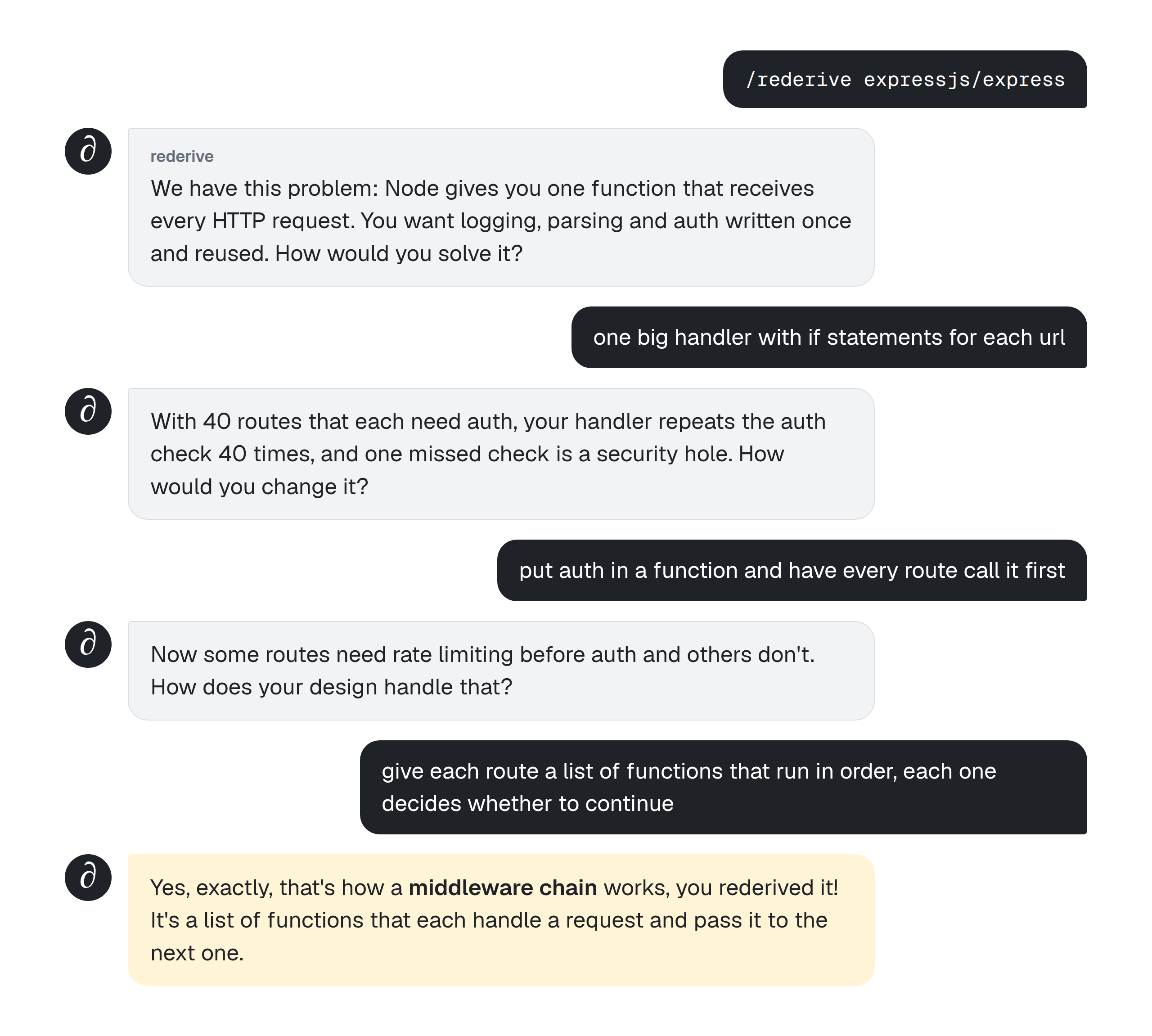
Point it at Express and it explains nothing: it asks questions until you have designed a middleware chain yourself
- Who
- By Eric Zou (EricJujianZou), MIT licensed, for people who must explain a project they built with AI or learn how a well-known one works.
- When
- Public since 19 October 2026. No release tag; the last commit was on 25 October.
- Where
- One command installs it in Claude Code, Codex, Cursor, Gemini CLI, opencode and more. Everything stays on your machine.
What was hard
Build a project quickly with AI and you may not be able to say why it is designed the way it is. Ask the agent to explain the code and a plausible answer comes back; it makes sense while you read it, and then an interviewer or a reviewer asks and you have nothing. Studying a famous open-source project goes the same way.
What it does about it
rederive does not explain. It gives you the first problem the project had to solve and asks how you would solve it, then adds the constraints that break your answer, one at a time. Fix it often enough and you arrive at the design the real code chose, and only then does it tell you the technique's name. When you are stuck it narrows the choices, and after two wrong answers in a row it offers to sketch the problem, but it never states the answer.
How it runs inside
- 1
You → rederive (SKILL.md)
/rederive, or /rederive <git URL>A git URL is cloned into the current folder; all state lives in that repo's .rederive/ folder.skills/rederive/SKILL.md - 2
rederive (SKILL.md) → You
The root problem first: how would you solve it?On your own repo it asks why you built it; on someone else's it states the original problem with no solution terms.skills/rederive/SKILL.md - 3
Your coding agent → scripts/history.sh
scripts/history.sh <repo>While you answer, a background subagent pulls the notable commits and the most changed files.skills/rederive/scripts/history.sh - 4
scripts/history.sh → Your coding agent
Entry points and the import graphstructure.py finds the most imported files and the links among the central ones.skills/rederive/scripts/structure.py - 5
Your coding agent → .rederive/map.md
5 to 10 decisions, in build orderEach has the problem, its constraints in order, the real design and the commit as evidence. It holds the answers.skills/rederive/SKILL.md - 6
rederive (SKILL.md) → You
One constraint at a time: now this breaksWhen you reach the real design it names the technique at once; before that it never reveals it, even when asked.skills/rederive/SKILL.md - 7
rederive (SKILL.md) → .rederive/log.md
Notes on each problemWhere you struggled and what you found on your own, so you can see what to practise.skills/rederive/SKILL.md
What goes in, what comes out
Is it for you
Good for
- Explaining a project you built with AI in an interview or a talk
- Learning by hand why a project like Express or Redis is shaped the way it is
- Understanding a new team's codebase rather than only reading it
- Practising system design with real code as the answer key
Not for
- It is built not to give you the answer, even when asked. It does not suit a moment when you need a quick summary.
- It needs git, bash and python3.
- The import-graph analysis covers JS/TS, Python, Go and Rust only (per structure.py).
- No release tag, and no commits since 25 October.
Reviewed by Devalley’s editor before publishing. How the column is made