
fast-anything: port only the slow 5% to Rust, with proof
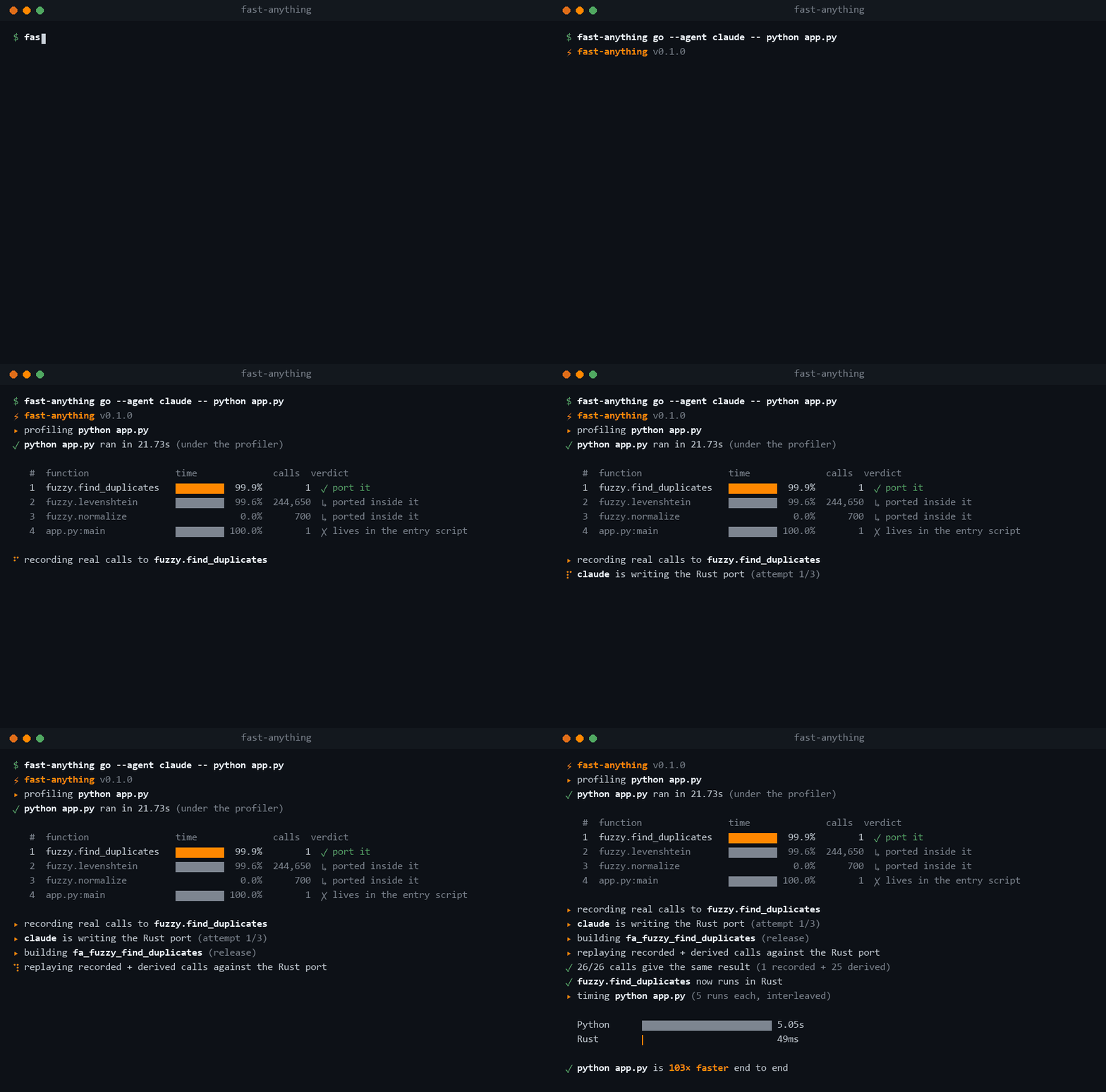
A Python script deduping 700 names went from 4.91s to 42ms after one function moved to Rust
- Who
- Made by EL4CTEO on GitHub, for developers who don't want to rewrite a whole slow app.
- When
- Public since November 21, 2026; the latest release is v0.8.8, from November 25.
- Where
- A Claude Code and Codex plugin, an MCP server and a CLI. Runs on your own Windows, macOS or Linux machine.
What was hard
Every time a script gets slow, rewriting it in Rust comes to mind, but moving a whole app costs months and minute-long compiles. And when you ask an agent to port just one function, reading the result doesn't tell you whether it behaves exactly like the original.
What it does about it
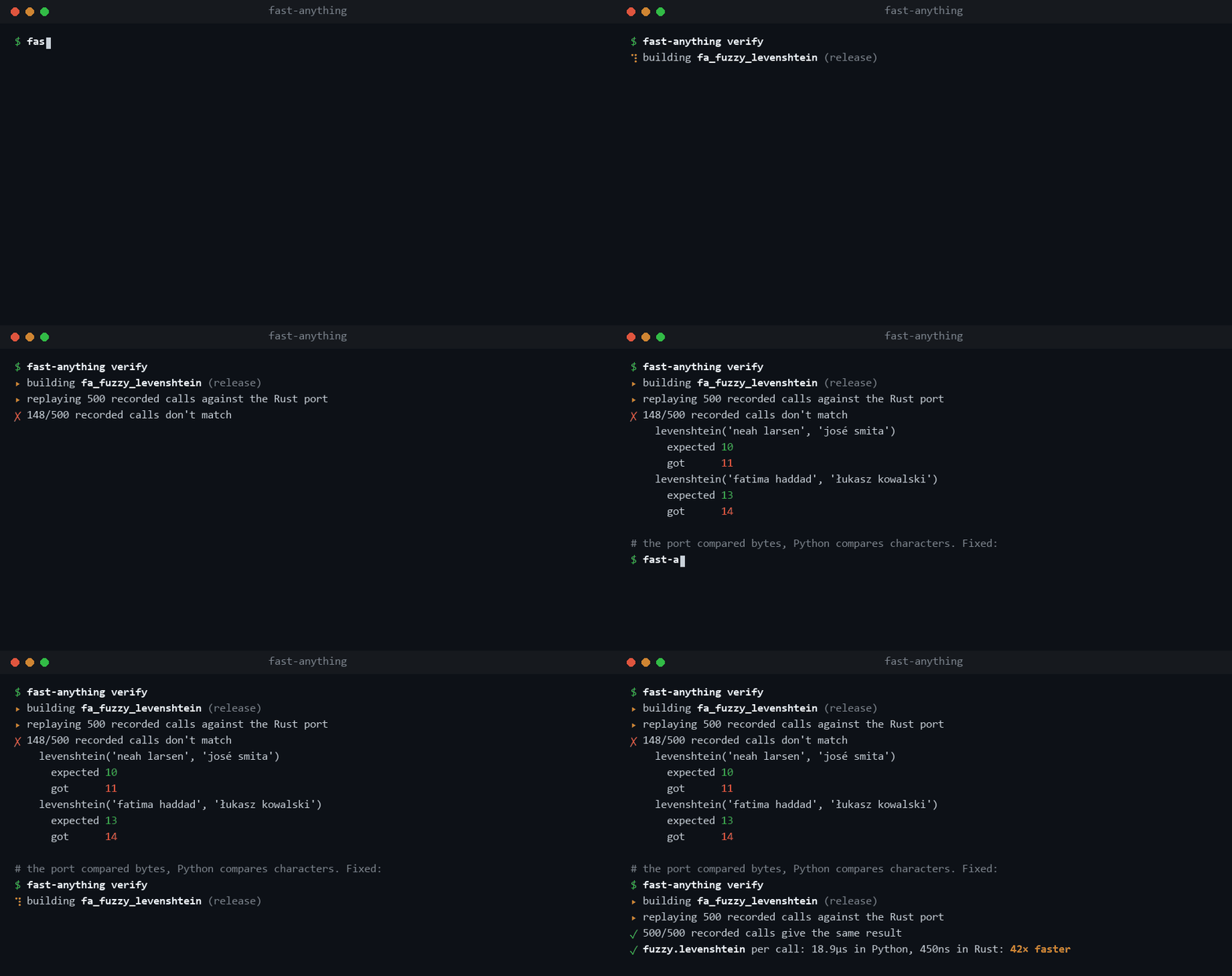
fast-anything runs your app, finds the functions that take the most time and has your coding agent port only those to Rust. Its key idea is proof: it records up to 500 real calls of the original, replays all of them against the Rust, and enables nothing until every one matches. Every fifth recorded call is kept where the agent can't see it, so a port that only fits the calls it was shown still fails.
What people made with it
A user who measured a Python reproduction of their renderer with 0.8.6 reported 20 findings with reproductions, among them wrong wording in bench and report.
Observed 8.42 s → 9.27 s, yet the report called it 0.9× faster.
A field report from someone who tried it for a Kotlin Android workout logger: doctor was useful, but 0.8.6 has no scan path for Android.
`doctor` is genuinely useful for the desktop matrix.
How it runs inside
- 1
You → fast-anything CLI
fast-anything go --agent claude -- python app.pyThe command you already run your app with goes after the dashes.src/main.rs - 2
fast-anything CLI → Your app (app.py)
scan: profile and rankEach function is scored by its time times how portable it is; anything that can't move gets a reason.src/hotspot.rs - 3
fast-anything CLI → .fast/ports/<id>/src/lib.rs
port: record up to 500 real calls, write TASK.mdIt runs the app again, records the function's real inputs and results, and creates a one-function Rust crate.src/pipeline.rs - 4
fast-anything CLI → Claude Code / Codex
Hand TASK.md to the agentclaude, codex, or any command that reads a prompt on stdin.src/agent.rs - 5
Claude Code / Codex → .fast/ports/<id>/src/lib.rs
Write the Rust in src/lib.rsThe original function stays untouched; the agent writes Rust with the same semantics.skills/fast-anything/SKILL.md - 6
fast-anything CLI → .fast/ports/<id>/src/lib.rs
verify: release build, replay every recorded callA mismatch goes back to the agent, and a port that is right but slower is not enabled.src/pipeline.rs - 7
fast-anything CLI → Your app (app.py)
enable: swap the Rust in with one marked blockdisable removes that block byte for byte.src/pipeline.rs - 8
fast-anything CLI → Report for your PR (md + SVG)
bench, reportRotated rounds of original, original again and Rust separate the gain from noise, then a card is made for your PR.src/bench.rs
What goes in, what comes out
Is it for you
Good for
- A Python, Node or Ruby script that takes seconds, when a full rewrite isn't worth it
- Checking with numbers that an agent's port matches the original
- Attaching a before-and-after card to a pull request
Not for
- It ports top-level, deterministic functions that take plain data. Functions doing file or network work are skipped, and scan says why.
- Building a port needs the Rust toolchain (rustup).
- The numbers above are the README's runs on an i5-10500 with Windows 11, not runs of our own.
- Kotlin support is for JVM Gradle projects. One user reported that 0.8.6 has no scan path for Android apps.
Reviewed by Devalley’s editor before publishing. How the column is made