
ECC: a harness that gives your coding agent a way to work
One npx line makes Claude Code plan, write a failing test, pass it and get a fresh-eyes review, in that order
- Who
- Maintained by Affaan Mustafa (@affaan) alone, for developers who work with coding agents such as Claude Code and Codex every day.
- When
- Public since January 2026, v2.0.0 in June, latest release v2.2.3 on 2026-10-01.
- Where
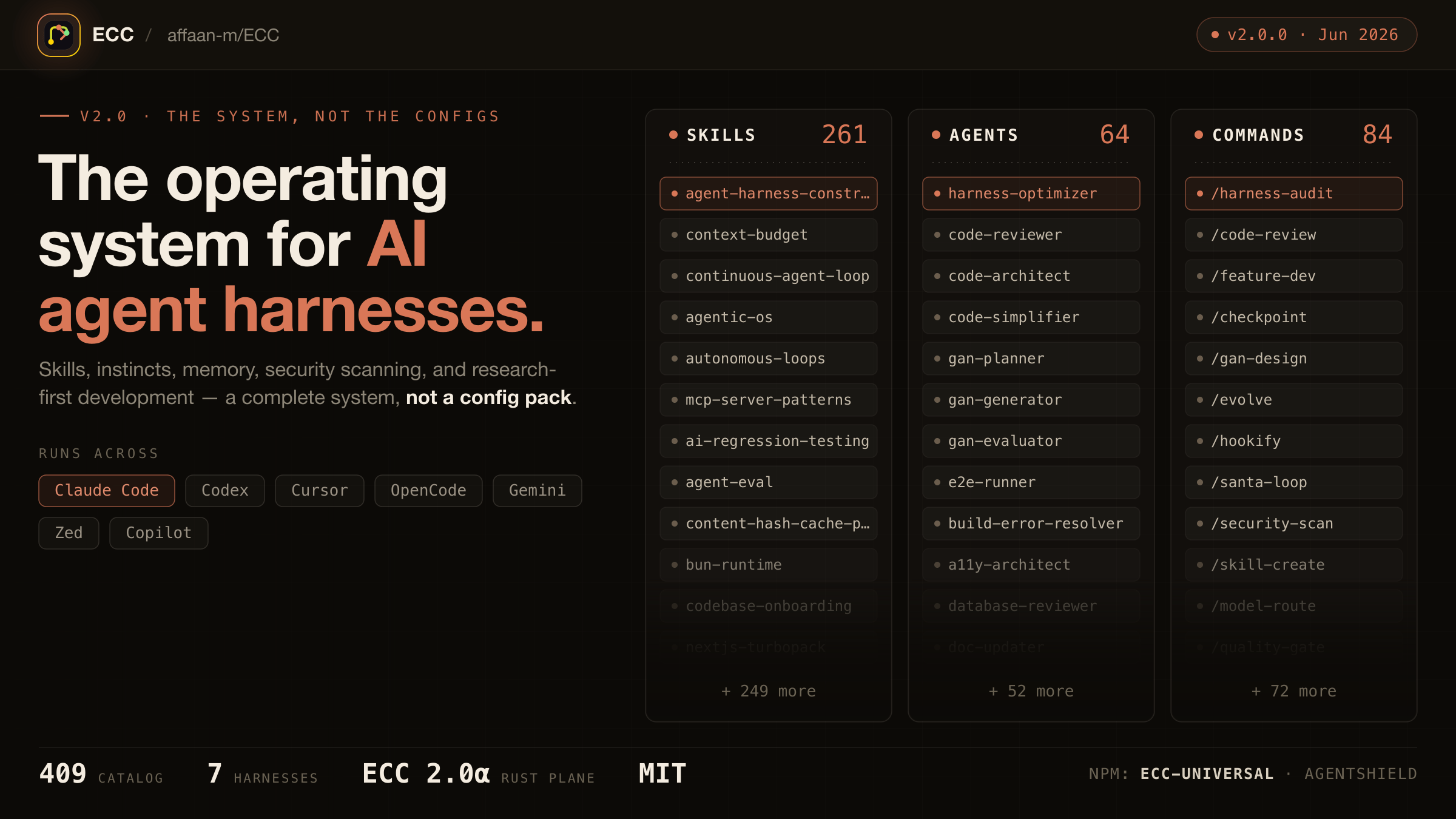
- Best in Claude Code; native plugins for Codex and Qoder; limited adapters for Cursor, OpenCode, Gemini, Zed. Runs on your machine.
What was hard
You tell Claude Code to write the tests first, and a long session later it has forgotten. Plans vanish into chat history, and the same context that wrote the code also reviews it. Every new session starts with explaining again where you left off.
What it does about it
ECC installs that discipline instead of asking for it. The plan becomes a document you can edit, tests-first becomes a gate that needs a failing test as evidence, and the review goes to an agent that did not write the code. What you get back is not just code but a trail: the plan, the failing test, the passing test, the review findings and the final check.
/ecc:plan "Add usage-based billing alerts"-> confirm or edit the plan-> activate tdd-workflow-> capture RED evidence before implementation-> implement until GREEN-> review from fresh context-> fix findings with regression tests-> verify build, lint, types, and tests
What people made with it
Built Jynx, a Flutter app for finding gaming teammates (214k lines of Dart), with Claude Code, and wrote on Show HN that its setup's instincts system came from ECC.
22 hooks, 18 skills, 13 instincts, 8 rule files, custom subagents, slash commands, MCP servers and plugins (instincts system from Affaan's
How it runs inside
- 1
You → /ecc:plan
/ecc:plan "the feature"Restates the request, lists risks and phases, and waits for your approval before touching any code.commands/plan.md - 2
/ecc:plan → tdd-workflow skill
the approved *.plan.mdTurns each planned task into a test, confirms it fails (RED), then implements just enough to pass (GREEN).skills/tdd-workflow/SKILL.md - 3
tdd-workflow skill → code-reviewer agent
git diffA reviewer in its own context reads the diff and the code around it, and reports only issues it is over 80% sure of.agents/code-reviewer.md - 4
code-reviewer agent → Claude Code
findings, CRITICAL to LOWClaude Code fixes the findings and runs a final build, lint, type and test check. - 5
Claude Code → Session summary file
Stop hook → *-session.tmpAfter each response it distills the transcript into a session file, and the next session's start hook loads it back.scripts/hooks/session-end.js
What goes in, what comes out
Is it for you
Good for
- Building features with Claude Code while asking for tests and reviews by hand each time
- Long work that has to continue in a new session the next day
- Using Claude Code and Codex side by side with the same skills in both
- Auditing the agent setup itself: hooks, MCP config and permissions
Not for
- Stacking install methods in one harness (a full manual install on top of the plugin) runs skills and hooks twice.
- Claude Code plugins cannot ship rules, so rule packs are copied from the repository by hand.
- Cursor, OpenCode, Gemini and others get capability-limited adapters, not feature parity with Claude Code.
- The hosted GitHub App for private repos and PR audits (ECC Pro) is paid; the open-source repo is MIT and free.
Reviewed by Devalley’s editor before publishing. How the column is made