
Auto Ontology: a meaning map so agents get your data right
NVIDIA's open-source layer answers a revenue question with $588.80, the SQL and the joins it took
- Who
- Built and maintained by NVIDIA, for data teams that want agents to answer questions over company databases with numbers they can trust.
- When
- The repository opened in April 2026; no release tags. The server package is at 1.2.0 and commits landed as late as November 10.
- Where
- Self-hosted with Docker Compose or Helm; reaches Claude Desktop or Cursor over MCP or API. Models: NVIDIA NIM or OpenAI-compatible.
What was hard
Ask an agent for last month's revenue and the SQL comes back in seconds. Which column holds revenue, and which tables to join in what order, is the agent's guess. The number looks fine, so someone still has to reread the query to know it is right.
What it does about it
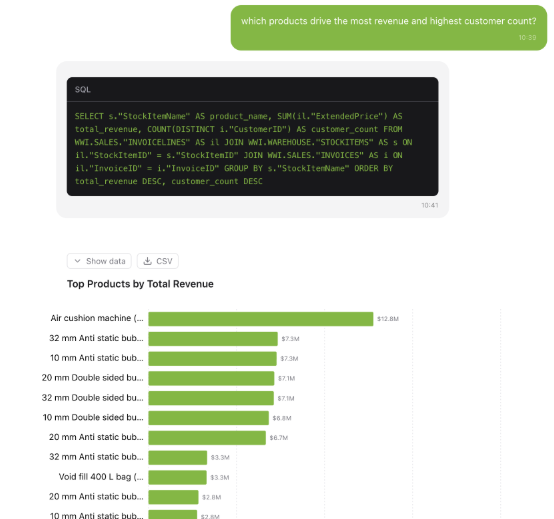
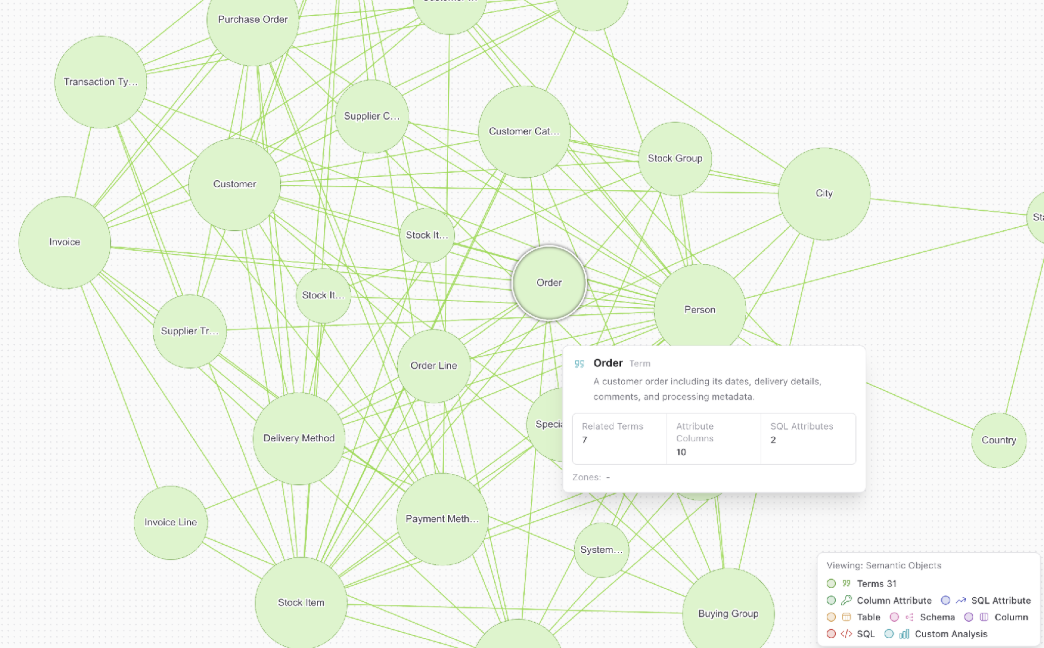
Auto Ontology reads your databases before any question arrives and builds a map: business terms like Customer or Invoice Line, the columns that hold them, how tables join, and reviewed SQL for measures. People fix and certify those definitions in a web UI. The agent then matches the words in a question to those terms and follows the join path, and every answer carries its SQL and steps so you can check it. Per the README, a question the data can't answer gets a clarifying question back instead of a number.
You: What was return on ad spend for the sushi roll flash drive in June 2015?Agent: check_answerable -> coverage 0.5; no term covers "ad spend"Agent: I can find revenue for that product, but this data has noadvertising spend, so I can't compute return on ad spend. Do youwant June 2015 revenue instead, or is ad spend tracked in anothersource I should connect?
What people made with it
Ran the quickstart's Wide World Importers data, asked for 2016's top 5 customers by revenue, and showed with steps that the SQL ranked them right while the chart sorted them A to Z.
A ranking answer ("top 5 customers by revenue") is charted in A→Z order, so the bar positions contradict the ranking given in the answer and SQL.
Ran v1.2.0 on their own workspaces with four questions about data that wasn't connected, and tabled how each came back: a stand-in table or a limit message.
When a question asks about data that isn't in any connected source, Auto Ontology does not say so.
How it runs inside
- 1
Source database → Ontology (Postgres + pgvector)
Schemas, column profiles, sample valuesTables and values from each connected database are extracted into the catalog that every later step reads.auto_ontology/catalog/ingest.py - 2
Source database → Ontology (Postgres + pgvector)
Terms, relationships, SQL attributesSemantic compilation goes table by table, has an LLM name terms, maps them to columns and embeds them in pgvector.auto_ontology/semantic/pipeline.py - 3
Claude Desktop · Cursor → auto-ontology-mcp
check_answerable → ask_questionThe agent first checks whether the ontology covers the question; all tools are read-only and run as the signed-in user.mcp/auto_ontology_mcp/tools.py - 4
auto-ontology-mcp → text-to-SQL graph
POST /api/chat/completionsThe MCP server passes the question to the web app's conversation API and reads the streamed result.mcp/auto_ontology_mcp/chat.py - 5
text-to-SQL graph → Ontology (Postgres + pgvector)
Term and column candidates per entityEach entity in the question is searched by embedding, and an LLM drops hits that don't fit the question's intent.auto_ontology/retrieval/text_to_sql/agents/candidates_retrieval.py - 6
text-to-SQL graph → Answer + SQL + steps
Write SQL → check values → runSQL is written from the candidates, its filter values and query are checked and repaired, then it runs and returns.auto_ontology/retrieval/text_to_sql/text_to_sql_graph.py
What goes in, what comes out
Is it for you
Good for
- Asking your company database questions in plain words from Claude Desktop or Cursor
- Teams whose metrics are defined differently across systems
- Checking an agent's number against its SQL and join path
- Data in PostgreSQL, MySQL, Snowflake, Databricks, DuckDB and five more engines
Not for
- Needs an NVIDIA API key (nvapi-) or an OpenAI-compatible endpoint whose models support structured output.
- Ports 3001 and 3002 trust a forwarded user header and ingestion has no auth of its own; keep them on a private network.
- Turning on KumoRFM for predictions uploads connected tables to that hosted service.
- Issue #497 reports cases where missing data was answered from a stand-in table or ended on a limit message.
Reviewed by Devalley’s editor before publishing. How the column is made