
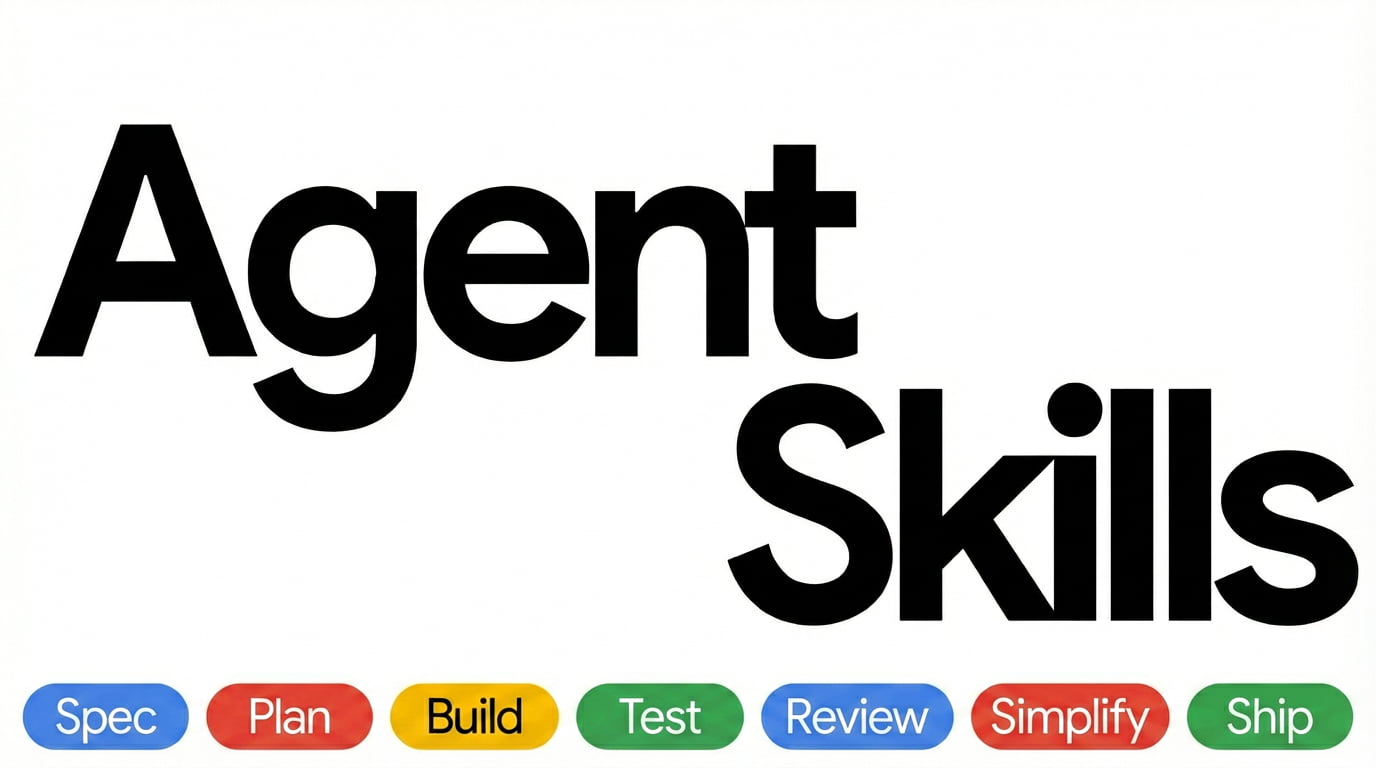
Agent Skills: 26 skills from spec to ship, in six phases
In a same-model, same-repo comparison, it ran the full 446-test suite and surfaced a hidden issue
- Who
- Created by Addy Osmani, maintained with Federico Bartoli and Joan León, for people who hand production code to AI coding agents.
- When
- Public since February 15, 2026. The latest release is 0.6.17, from November 18, 2026.
- Where
- Claude Code, Codex, Cursor, Gemini CLI, Antigravity CLI, GitHub Copilot, OpenCode and more. Skills install into your repository as Markdown.
What was hard
Hand a feature to an agent and it writes code with no spec, says it will add tests later, and calls the work done without running anything. So every task starts with the same reminders typed again: spec first, test first, review first.
What it does about it
Agent Skills writes those reminders down once, as skills across six phases (define, plan, build, verify, review, ship), each phase behind a slash command. What sets this pack apart is the excuse table inside every skill: the lines an agent uses to skip a step, each with its rebuttal, and an ending that asks for evidence such as passing tests or build output. The evals that check whether a skill fires when it should live in the same repository.
What people made with it
Built one feature with Superpowers and with Agent Skills on the same model, repo and prompt. Agent Skills reached code 4 minutes sooner and made 7 validation passes, ending on the full 446-test suite.
The result was a 4-minute faster first code change (8 vs 12 minutes) without affecting total execution time.
Wrote eval suites for three of the pack's skills and measured them across a model release. code-review-and-quality held up; the other two showed regressed cases, posted with tables.
For our first report I wrote eval suites for three skills from this repo (code-review-and-quality, git-workflow-and-versioning, documentation-and-adrs)
How it runs inside
- 1
Developer → Claude Code
/specThe agent first asks about the objective and users, core features and acceptance criteria, stack and boundaries..claude/commands/spec.md - 2
Claude Code → SPEC.md
Save SPEC.mdSix areas go into the project root: objective, commands, structure, code style, testing strategy, boundaries.skills/spec-driven-development/SKILL.md - 3
SPEC.md → tasks/plan.md
/plan → tasks/plan.mdThe spec is cut into small tasks, each with acceptance criteria and a dependency order.skills/planning-and-task-breakdown/SKILL.md - 4
tasks/plan.md → Claude Code
/build: RED → GREEN → commitIt takes the next task: failing test, minimum code, full suite, build, commit, then stops..claude/commands/build.md - 5
Claude Code → code-reviewer + 2 personas
/ship: 3 personas in parallelcode-reviewer, security-auditor and test-engineer each read the same change in their own context..claude/commands/ship.md - 6
code-reviewer + 2 personas → Ship Decision: GO | NO-GO
3 reports → GO | NO-GOThe main agent merges the reports into one decision with blockers, recommended fixes and a rollback plan..claude/commands/ship.md
What goes in, what comes out
Is it for you
Good for
- Handing an agent a feature bound for production while keeping a human check at each phase
- Being uneasy when code arrives before a spec or a test
- Running code review, a security audit and a test-coverage pass together before launch
- Teams on several agent tools that want one working order
Not for
- Installing a single skill with npx leaves out the repo-level references/ checklists (README, issue #361).
- The /spec to /ship slash commands are Claude Code commands; in GitHub Copilot you invoke the skills by name.
- /build auto only removes the human stepping between tasks. It is not faster per task.
- This piece is drawn from the README and the command and skill files, not from a run of our own.
Reviewed by Devalley’s editor before publishing. How the column is made