
SolidCraft: open-source parametric CAD your agent can drive
Someone had Claude Code model their house's staircase without touching the CAD tools
- Who
- Tangency Labs' open-source parametric CAD in Rust, for people who model by hand and people who hand it to an agent. MIT or Apache-2.0.
- When
- The repository opened on 7 October 2026; the latest release is v0.26.0, from 29 October 2026.
- Where
- Windows, macOS and Linux desktop, or the browser. Over MCP: Claude Code, Codex, Cursor, Gemini, Claude Desktop and more, on your machine.
What was hard
Ask an agent for a part and what you usually get back is a single mesh. Want it a little taller? You ask again from scratch, and there's no history to open and see how it was built.
What it does about it
SolidCraft puts an MCP server inside a CAD app people already use by hand. The agent's calls become the same engine commands as the toolbar buttons and land one by one on the feature timeline; leave the app open and you watch the model take shape in its window. What you get is an editable design, so changing a single parameter recomputes every feature after it.
What people made with it
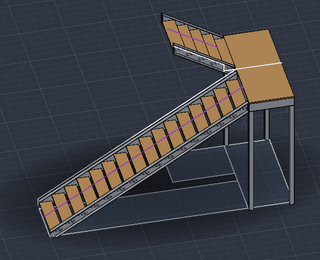
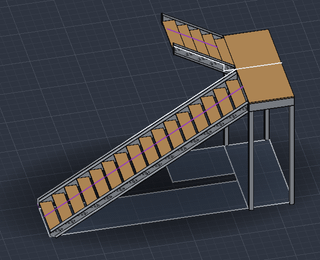
A half-turn staircase for their house, described to Claude Code in plain words. Change the height or riser count and it all rebuilds; the structural check is in Python.
The whole model was built by Claude Code through SolidCraft’s MCP connector. I described what I wanted in plain language, Claude created the sketches and features
Telecaster guitar bodies from PDFs they had, then bindings and a kill switch added by desktop ChatGPT. The first run left out the wire holes between the pickup pockets, they note.
Took seconds to have desktop ChatGPT add bindings, add a kill switch just for fun.
SELENE, a rover built only through SolidCraft's MCP commands: 1,395 bodies and 3,324 history entries, released as an editable native file plus STEP and 3MF.
The rover has six driven wheels, visible suspension and dampers, an articulated sampling arm, a camera and lighting turret, deployable solar panels, a steerable dish
How it runs inside
- 1
Claude Code → solidcraft-cli mcp
tools/call batch {commands: [...]}One JSON-RPC line over stdio; the server checks the arguments and runs the tool inside the agent's folders only.crates/mcp/src/server.rs - 2
solidcraft-cli mcp → Headless engine session
engine.execute {command, params}Each tool becomes an engine command: set_parameter runs parameters.change, export runs file.export.crates/mcp/src/tools.rs - 3
solidcraft-cli mcp → Headless engine session
edit.checkpoint → edit.restore_checkpointA batch takes a checkpoint first; if any step fails, the design and undo history go back to where they were.crates/mcp/src/tools.rs - 4
solidcraft-cli mcp → SolidCraft app (control port)
engine.batch over the 127.0.0.1 control portWith the app open and nothing built yet, it bridges there, sends that launch's token and runs a batch in one frame.crates/mcp/src/backend.rs - 5
Headless engine session → PNG screenshot · STEP file
ui.render → PNG, file.export → STEPHeadless, it renders the model on the GPU (or CPU) and returns a PNG; export writes STEP, 3MF, STL and more.crates/mcp/src/backend.rs
What goes in, what comes out
Is it for you
Good for
- Trying out cases or brackets for 3D printing with an agent such as Claude Code or Codex
- Getting an editable design with real dimensions back instead of a single mesh
- Watching an agent model in the app window and stepping in midway
- Using a feature-timeline CAD that is free and open source
Not for
- Still early and suited to simple parts: 75 of 76 public reference parts match their volume, area and centre of mass; the other is a tracked bug.
- The Windows downloads aren't signed yet, so SmartScreen needs More info, then Run anyway.
- The agent can only save in set folders, like the open design's; add others with --allow-path.
- Calls bridged to the app don't get parameter checking yet.
Reviewed by Devalley’s editor before publishing. How the column is made