
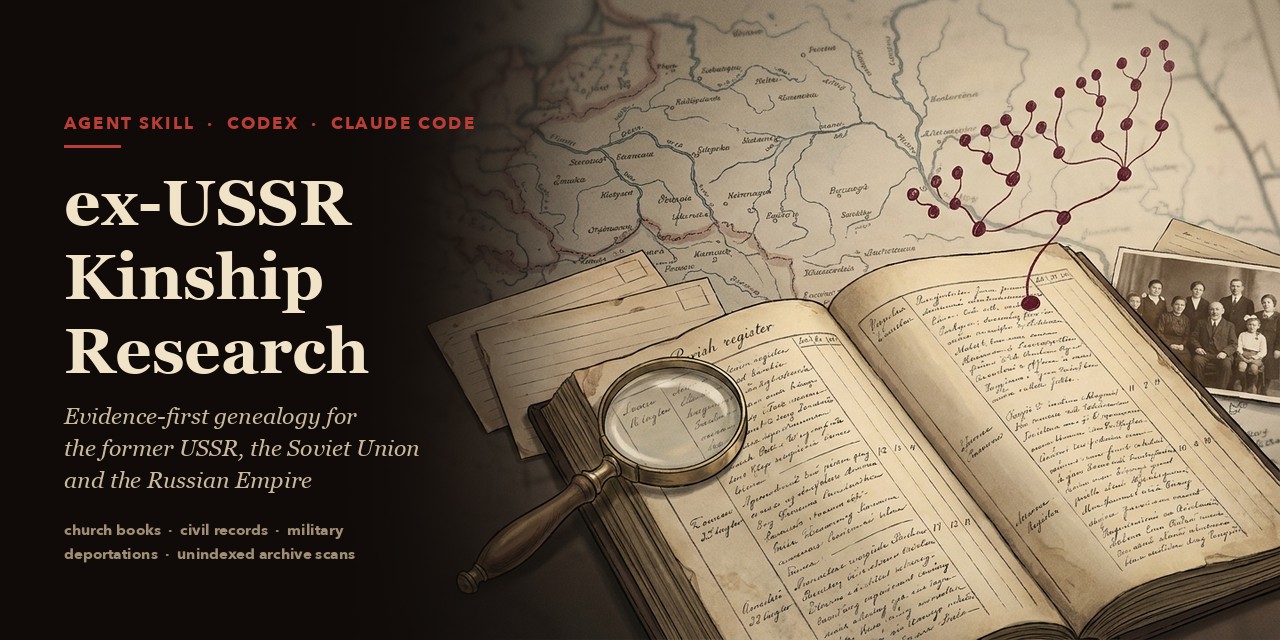
ex-USSR Kinship Research: evidence-first genealogy skill
One user had Claude Code read about 330 parish-book scans and came away with about 25 records of a single surname.
- Who
- Made by Denis Shiryaev (@DenisSergeevitch) for people tracing ancestors through records of the former USSR and the Russian Empire.
- When
- Published on 25 October 2026; the latest release is v1.22.0 from 29 October.
- Where
- Codex, Claude Code and other Agent Skills runtimes. Scripts need only Python 3's standard library; case folders stay on your machine.
What was hard
You find a 1902 marriage record, then the same entry turns up on an index site and in someone else's tree, and it starts to feel like three pieces of evidence. A man of the same name and age in the next village looks like a match too. Once one of those slips in, everything built on top of it is shaky.
What it does about it
The skill has the agent log every new find as an artifact, not a fact. Copies, indexes and mirrors of one record share an independence_group, so no relationship becomes corroborated until two independent lines of evidence agree. Namesakes stay separate people until something distinguishes them: a house number, parents, godparents, an exact birth date or a military unit. At the end a script rereads the registers and flags any claim marked as confirmed without enough independent groups behind it.
What people made with it
On an Elovo parish case in Claude Code, they had it read about 330 unindexed parish-book scans from 1887–1894 and got about 25 records of one surname, then wrote up what the scans cost.
Контекст: дело по Еловскому приходу (Осинский уезд), Claude Code, версия навыка 1.8.0.
They ran more than ten agents on one family at once, each on its own branch, and sent a pull request so the agent hands over its notes on the skill at the end of the work.
В нашем деле одновременно работали больше десяти агентов, каждый над своей веткой семьи.
From a real two-branch case, Altai peasants and a Crimean Tatar family, they sent rules such as searching by volost and checking that a birthplace existed on the event date.
Lessons from a real two-branch case (Altai peasants and a Crimean Tatar family).
How it runs inside
- 1
You → Codex · Claude Code
A family question, scans, known factsSKILL.md is in Russian but tells the agent to reply in your language and search in the records' languages.SKILL.md - 2
Codex · Claude Code → init_case.py
init_case.py --case-dir ~/kinship-cases/…Copies the templates from assets into a case folder, and refuses to put a case inside the skill folder.scripts/init_case.py - 3
Codex · Claude Code → Case registers (CSV)
Artifact and SHA-256 into artifact-register.csvEach find gets its provenance, originality, directness and independence_group, plus a file hash.scripts/hash_artifact.py - 4
Codex · Claude Code → Case registers (CSV)
Claim and status into claims-register.csvA link stays single-source until two independent groups support it.assets/claims-register.csv - 5
audit_evidence.py → Case registers (CSV)
Cross-checks the four registersWarns when a corroborated claim has fewer than two groups and errors on a group no cited artifact belongs to.scripts/audit_evidence.py - 6
Codex · Claude Code → report.html
report.htmlBuilds an HTML report with a family tree on top and each relationship one click from its evidence.assets/report.template.html
What goes in, what comes out
Is it for you
Good for
- Confirming ancestors from the former USSR or the Russian Empire with documents
- Working out whether a pile of certificates and scans points to one person
- Handing your family a report where every link shows its evidence
- Turning an existing tree into a GEDCOM file with sources attached
Not for
- It will not look up current addresses, phones or accounts of living people.
- It tries a CAPTCHA once and leaves sign-ins to you; it does not get around paywalls or geo-blocks.
- PDF is exported only on request and needs Chrome, Chromium or Edge.
- Installing tree apps, configuring MCP connections and syncing external trees are outside its scope.
Reviewed by Devalley’s editor before publishing. How the column is made