
earshot: ears for coding agents
Its author made every sound in a 22-second launch film in code, with no recordings and no music track
- Who
- Made by Leon Lin (Leonxlnx), for coding agents that build films, demos and games in code.
- When
- Released as 0.1.0 on 15 October 2026; the latest is 0.4.0, from 22 October.
- Where
- Runs locally on CPU only, no GPU. A CLI, a Python API and an MCP server for Claude Code and other agents.
What was hard
An agent can write the code that renders a launch film or a product demo, but it cannot hear the result. A hit that lands 80 ms after the cut, a key press that sounds cheap, music that swells in the wrong place: the agent has no way to notice. So a person has to listen every time and describe in words what is off.
What it does about it
earshot turns sound into evidence an agent can read: what a file sounds like in words, how well it fits a description as a score, and how far it sits from a picture cut in time. Hearing also makes making possible. The agent writes a sound as a physical-synthesis recipe in code, earshot renders candidates and judges them, and the agent reads the critique, rewrites the recipe and runs it again.
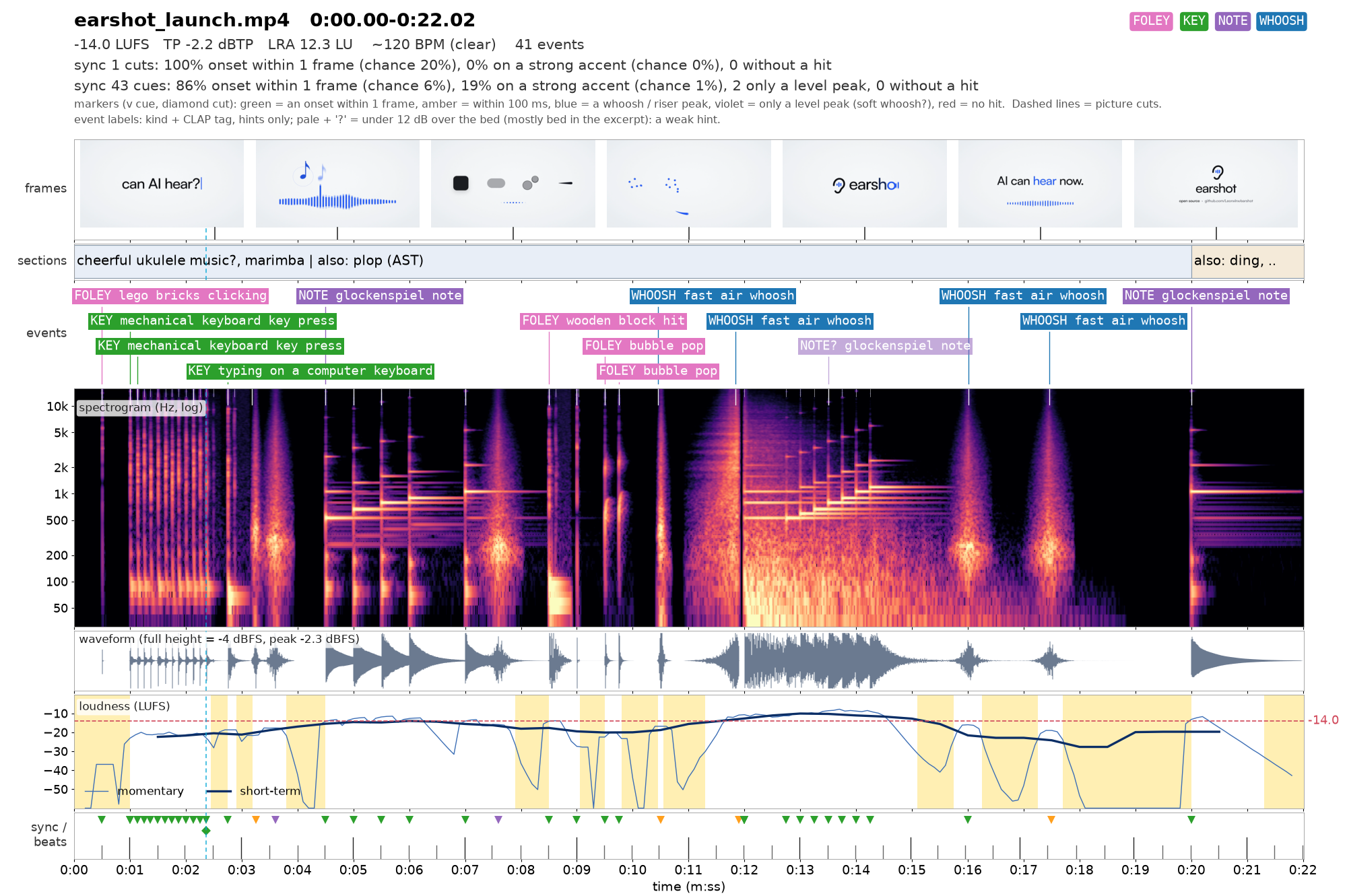
earshot describe enter.ogg0.56 s short transient (attack 3 ms, decays in 190 ms). Sounds most like: a single mechanical keyboard key press(z +5.4), a soft key release click (z +3.6) ... [clear reading]. peak -0.1 dBFS, brightness 1.5 kHz ...earshot match key.ogg "a deep thocky mechanical keyboard press" --alts "a clicky blue switch keyboard" "a mouse click"-> strong (z +3.7; would rank #2 among 322 vocabulary descriptions) ...earshot find keys.ogg "a single mechanical key press" --top 40:03.94-0:04.19 (0.24 s stroke, z +4.1 strong); 0:10.60-0:10.86 ...earshot critique film.mp4VERDICT: close - 21 of 23 scored metrics in range ... FIX FIRST: 1. [major] nothing reaches body level until 0:01.01 ...
How it runs inside
- 1
Claude Code → earshot MCP server
calls describe enter.oggThe MCP server keeps the models loaded and takes one tool call at a time.earshot/mcp_server.py - 2
earshot MCP server → CLAP and AST models
the sound against the vocabularyCLAP scores the sound against vocab.json's descriptions as z values; AST adds AudioSet labels.earshot/describe.py - 3
CLAP and AST models → Claude Code
'a single mechanical keyboard key press (z +5.4)'It comes back as one paragraph, with measurements such as length, attack and decay.earshot/describe.py - 4
Claude Code → impact.py recipe
a physical-synthesis recipe in codeA render() that computes contact, air shock, membrane, sub and hall in layers, with no recording.earshot/forge/recipes/impact.py - 5
impact.py recipe → forge critic
renders, pre-screened by measurement1/3-octave balance and envelope rank many renders without models; only the best are heard by CLAP.earshot/forge/search.py - 6
forge critic → Claude Code
'decay +2.4 outside the refs'The agent reads the critic's words, rewrites the recipe and runs it again.earshot/forge/critic.py - 7
forge critic → WAV and report.md
WAV, report.md, compare.png, audition.wavThe picks, their critique, spectrograms next to the references and a file to listen in pairs.earshot/forge/__init__.py
What goes in, what comes out
Is it for you
Good for
- Building launch films, product demos or games in code and letting the agent handle the sound too
- Picking the candidate sound that best fits a description out of many downloads
- Trimming the right moment out of a long recording, or checking that sounds land on the cuts
- Making sound effects in code, with no recordings, and varying them
Not for
- The first use downloads two open models (about 1.1 GB), and each CLI call loads them for 20-40 s; for many calls use the MCP server.
- It cannot judge taste or emotion, provenance or licences, speech content, or anything above 14 kHz.
- The reference recordings forge compares against are licensed and not in the repo; bring your own to compare with real ones.
- The optional LLM critique needs your own Gemini key and your consent to upload the audio.
Reviewed by Devalley’s editor before publishing. How the column is made